|
|
|
|
The following pond care tips are recommended mostly for a “Biologically Filtered System" just like the systems we install with a Biofalls waterfall container and a skimmer box. As always, if there is any way we can be of further service, please don't hesitate to give us a call.
 BACK TO BASICS: Maintaining your pond is not rocket science (more like rock science).
- The monthly service includes REMOVING the skimmer filter pad (or brushes) that is/are located beneath/behind the net basket and rinsing it/them with a garden hose (some people forget that there is even a filter pad down there)
- The once a year service includes shutting down the pump, removing the lava rock bags. Remove the filter pads from the Biofall container and rinse them thoroughly, remove the dirty water then proceed to place the filter pads and lava rock bags back into the Biofalls. Plug in the pump.
- Don't forget to add your beneficial bacteria ("Aquaclearer") every week.
Wasn't that easy?
THE ROLE OF GRAVEL IN YOUR POND: The rocky bottom is totally alive and brimming with activity, covered in algae, microscopic invertebrates and bacteria. This section of the pond is basically a compost pile. When organic debris falls to the pond's bottom, it is broken down by the benthic (bottom) inhabitants. These organic recyclers will live off of uneaten fish food, decaying plant matter and nitrogenous fish wastes. If this substrate was not present, the pond would quickly die, effectively being suffocated by toxic fish waste and organic buildup. Fortunately, nature has given us a way to solve this problem. Organisms have evolved to use practically every bit of available food. Fish, crustaceans and aquatic insects will feed on these minute organisms, including bacteria and algae that live on the rocky pond floor.
THE YEARLY POND CYCLE: Most ponds undergo an algae cycle every year. When the climate becomes colder (winter time), both the plants and bacteria will go dormant due to a lack of oxygen in cold water, creating advantageous conditions for algae growth. Without the competition from plants and bacteria, algae will take full advantage of the available nutrients in the pond. Do not be discouraged if your pond develops a lot of string algae during the winter. When the warmer temperatures return and stabilize, and the plants and bacteria establish themselves once again, the ecosystem will become balanced and the algae growth will decrease. Of course some ponds will take longer to achieve this balance. With an OASE filtration system retro-fit you can rest assured that you won't have to deal with this problem ever again! Please see our Features page for more information.
LAST MINUTE WINTER NOTES:
- Plants and Debris: Remove plant debris and other organic matter from the pond, because the debris will become nutrients for algae.
- Fish: When water temperature reaches 50 to 55 degrees, stop feeding your fish. At this temperature, their metabolism slows down and eating can make them sick or even cause death.
- Bacteria: Discontinue bacteria treatments when the water temperature reaches 50 to 55 degrees, the bacteria does not work at these temperatures and using it would be a waste of money.
- Annual Pond Cleanouts: This is the best time of the year to have this service done (which we offer) because everything is in a kind of dormant state and is less likely to go through the green water period.
 FISH FEEDING 101: Providing a proper environment and proper nutrition needed to keep your fish alive and healthy, will allow them to live longer and healthier. Since there are so many variables behind your pond fish's growth rate, performance and potential should be predominantly attributed to their environment.
HOW OFTEN SHOULD I FEED MY FISH? Fish can survive in artificial ponds simply by foraging on aquatic plants, algae, and insects in the water. With that said, logic dictates that the more fish you have in your pond can lead to lesser amounts of food per fish. Without a doubt, the majority of pond hobbyists enjoy feeding their fish whether or not it was their original intention. This situation can lead to the common problem overfeeding which has a proportionate relationship with, you guessed it, water quality! More food equals more waste and more waste yields poorer water quality conditions. Of course this just means you would have to clean your filters more often than normal and also add more beneficial bacteria (which helps in the breakdown of excess organic matter in the pond). Just keep in mind, poor water quality conditions can lead to a poor environment, which ultimately can lead to potential health problems! Fall is the time to make sure that you are generously feeding your fish. They need plenty of food now so they can store excess nutrients to help get them through the cold winter months. The usual rule of thumb still applies...only feed them what they can eat in five minutes. Continue to feed your fish as long as they are active and the water temperature is at least 55 degrees F. At temperatures below 55, their metabolism and overall activity slows down while they prepare for hibernation. One little note - when you introduce new fish to your pond, don't expect them to eat right away. It may take a day up to a few days before they get used to their new surroundings and work up an appetite.
SO WHAT SHOULD I FEED MY FISH? You ask. Follow this simple concept: higher quality foods yield more digestible ingredients and, therefore yield less waste on the "other end," Voila! (that's French for: Ta-Daa!). Anyway, higher digestibility means that the fish that consume it use more of the food's ingredients which ultimately means higher nutrition for the fish and better water quality in the pond and hence the world will be a better placed to swim in! Pond fish are omnivorous and eat a wide variety of foods (as you might have experienced). Koi fish food comes in round pellets or sticks that either sink or float (but not both, hee hee). Of course live food is the best because they are natural foods and have a high nutritional content. Many live foods are also available in frozen form. Earthworms can be purchased from bait and tackle shops, Kingworms (more commonly known as Mealworms) can also be purchased at certain reptile pet stores. Both are often relished by Koi and goldfish of all shapes and sizes (yummie!). Other treats for your pond fish may be romaine lettuce, watermelon, oranges, grapefruit and peas. It's best to create variety in fish diets.
NUTRITIONAL REQUIREMENTS: The main objective of feeding fish is sustenance, nutrition (to build muscle and keep the body firm without making the fish fat), and aesthetics (to enhance and maintain the fishes' color). A range of 25 to 50 percent of the fish diet should be protein which is a primary source of energy. Fats and lipids can comprise of 10 to 12 percent of the diet for fish. Fish easily digest unsaturated fats, whereas saturated fats are poorly digested. Less then 20 percent of the fish diet should be carbohydrates which are the fishes' main source of energy (and don't let them forget to exercise regularly). One last note - the first ingredient on the label should not be corn or soybeans but a high quality protein source such as fish meal!
FISH FEEDING 101: Providing a proper environment and proper nutrition needed to keep your fish alive and healthy, will allow them to live longer and healthier. Since there are so many variables behind your pond fish's growth rate, performance and potential should be predominantly attributed to their environment.
HOW OFTEN SHOULD I FEED MY FISH? Fish can survive in artificial ponds simply by foraging on aquatic plants, algae, and insects in the water. With that said, logic dictates that the more fish you have in your pond can lead to lesser amounts of food per fish. Without a doubt, the majority of pond hobbyists enjoy feeding their fish whether or not it was their original intention. This situation can lead to the common problem overfeeding which has a proportionate relationship with, you guessed it, water quality! More food equals more waste and more waste yields poorer water quality conditions. Of course this just means you would have to clean your filters more often than normal and also add more beneficial bacteria (which helps in the breakdown of excess organic matter in the pond). Just keep in mind, poor water quality conditions can lead to a poor environment, which ultimately can lead to potential health problems! Fall is the time to make sure that you are generously feeding your fish. They need plenty of food now so they can store excess nutrients to help get them through the cold winter months. The usual rule of thumb still applies...only feed them what they can eat in five minutes. Continue to feed your fish as long as they are active and the water temperature is at least 55 degrees F. At temperatures below 55, their metabolism and overall activity slows down while they prepare for hibernation. One little note - when you introduce new fish to your pond, don't expect them to eat right away. It may take a day up to a few days before they get used to their new surroundings and work up an appetite.
SO WHAT SHOULD I FEED MY FISH? You ask. Follow this simple concept: higher quality foods yield more digestible ingredients and, therefore yield less waste on the "other end," Voila! (that's French for: Ta-Daa!). Anyway, higher digestibility means that the fish that consume it use more of the food's ingredients which ultimately means higher nutrition for the fish and better water quality in the pond and hence the world will be a better placed to swim in! Pond fish are omnivorous and eat a wide variety of foods (as you might have experienced). Koi fish food comes in round pellets or sticks that either sink or float (but not both, hee hee). Of course live food is the best because they are natural foods and have a high nutritional content. Many live foods are also available in frozen form. Earthworms can be purchased from bait and tackle shops, Kingworms (more commonly known as Mealworms) can also be purchased at certain reptile pet stores. Both are often relished by Koi and goldfish of all shapes and sizes (yummie!). Other treats for your pond fish may be romaine lettuce, watermelon, oranges, grapefruit and peas. It's best to create variety in fish diets.
NUTRITIONAL REQUIREMENTS: The main objective of feeding fish is sustenance, nutrition (to build muscle and keep the body firm without making the fish fat), and aesthetics (to enhance and maintain the fishes' color). A range of 25 to 50 percent of the fish diet should be protein which is a primary source of energy. Fats and lipids can comprise of 10 to 12 percent of the diet for fish. Fish easily digest unsaturated fats, whereas saturated fats are poorly digested. Less then 20 percent of the fish diet should be carbohydrates which are the fishes' main source of energy (and don't let them forget to exercise regularly). One last note - the first ingredient on the label should not be corn or soybeans but a high quality protein source such as fish meal!
 Well, here we are again talking about all that green stuff (algae) in your pond that can literally appear overnight, as some of you have experience. I bet you didn't know that pondering can be so much fun? All kidding aside, listed below are ten algae problem solutions that really work.
- Beneficial bacteria with enzymes play an enormous role in balancing your pond and providing you with a low maintenance water feature. The bacteria should be added regularly (at least twice a month) throughout the year. The bacteria will compete with the algae in the pond for excess nutrients, essentially starving off the algae. Remember to clean you Biofall filters no more than twice a year.
- Plants directly compete with algae for nutrients and sunlight, and are probably the most important addition to your pond. Make sure you add a wide variety of aquatic plants to your pond. This not only creates a natural look, but will also help reduce the algae in your pond.
- Place water hyacinth and water lettuce (these are both floaters) in the pond area and in the Biofalls (use fishing line to prevent the plants from flowing over the falls). These plants reproduct rapidly (in warmer weather) and use up enourmous amounts of nutrients.
- Plenty of marginal plants such as cattails and iris are very good for your pond because they also take up large quantities of nutrients. They are hardy and will be back each year to help you balance your pond.
- Placing water lilies in your pond will aid in the reduction of algae as well. The larger lilie pads will soak up the warm sunlight, therefore allowing less sunlight from reaching the deeper portions of your pond. Removing the lilie from the pot with its soil and placing it between the gravel will allow the water lilie to grow bigger and healthier.
- Koi fish are worth their weight in gold (when it comes to keeping your pond algae-free). I cannot stress enough how beneficial these beautiful creatures can be to your pond. I know a lot of you went out and got these cute, little 2-4 inch Koi fish (and named every one of them) with all kinds of plans for them when they got bigger (years from now). And within a week, you noticed that Sparky was missing, then Spotty, and then Fred. "Where did they go, Mommy?" Your little daughter or son asks you. You will need to invest in larger Koi fish, not only because they are voracious eaters but so you won't have to worry about Charlie just disappearing one day in the "Bermuda Pond." Limit your feeding, think of fish food as fish treats. Try not to feed your fish more than 2-3 times per week because guess what they'll eat if you don't feed them? Bingo - all that green stuff!
- Remove decomposing material such as leaves, pods, nuts and trash from the bottom of your pond. Over time, all this debris becomes food for the algae, yummie!
- Barley straw is another way to keep algae in check. The barley is usually placed in the Biofalls. The barley begins to decompose about 6 weeks later, and this is when an interaction occurs between the barley and the algae. The barley will last around 3-4 months (and then should be replaced).
- Create shade for your pond! Algae thrives with direct sunlight. Plant trees (that will give more afternoon shade) near your pond. Maybe even building a lattice cover or an arbor would help a lot, not to mention making your pond a small haven now where you can have all kinds of viney plants growing on your trellis.
- Physical removal of the clumps of string algae if it begins to overtake the pond is very helpful.
- Run-off control is very important to having a well-balanced ecosystem. Never use lawn fertilizer or insecticides on trees around your pond or an areas of your property that will drain toward your pond. Lawn fertilizer and insecticides will cause large algae blooms, as well as severaly threaten the aquatic life in your pond.
- Avoid spraying for pests and weeds with 20 feet of your pond and don't even think about spraying front or back yards on a windy day! All it takes is just a very small amount of mist from the spraying and your pond will experience the same problems as the run-off above.
- Your "Auto-Fill" Float should be checked monthly because if it is filling your pond all the time, the algae will thrive with all the new nutrients being introduced to your pond, and besides, it's not good for your fish.
 Causes of "pea-green soup" pond water and how to avoid them
By Jamie Beyer, Midwest Waterscapes
POND Trade Magazine
Pea-green soup water in ponds is the result of a bloom of single-celled planktonic algae. This algae is free-floating algae, which is different from string, or filamentous, algae. Free-floating algae requires different control methods than those required for string algae. Compared with string algae, planktonic algae is much easier to deal with. Being able to recognize what causes these single-celled algae species is an important part of this equation.
Planktonic algae is caused by an excess of nutrients in the water and not enough "critter" (bacteria, invertebrates, and good algae) to use them up. Most of these critters' homes are in a layer of life that I call the PATINA of a pond. Most ponderers would recognize this as the "slime layer." It grows on everything that dissolved oxygen (DO) -rich water touches - rocks, the liner, plant pots, etc. These microscopic animals also float around in the water, but most exist within the patina layer.
The amount of algae (and thus the clarity of the water) can vary, from a just some algae to a huge algal bloom (i.e., pea-green soup). Cold water temperatures inhibit algal reproduction and growth. This is why most ponds are clearest in winter. Clarity can vary from zero inches of visibility to several feet. Ideal clarity is when one can see the bottom of a 30-inch deep pond. Do not expect swimming pool clarity.
Suspended sediments, such as soil particles and tannins, can also affect clarity. To determine if sediment is the cause of reduced clarity, I recommend taking a sample of the pond water in a clear glass. Set the glass down for maybe 15 to 30 minutes so that any sediment settles to the bottom of the glass. Backlight the glass to observe. If there is no sediment in the bottom of the glass, then planktonic algae and/or dissolved tannins from organic matter will be the likely cause of reduced water clarity. These two will stay suspended for a much longer period of time. Usually, tannins are brownish in color and algae are green, so it is fairly easy to determine which one is clouding the water. Dealing with tannins and sediment will not be discussed here.
Any one of the following 30 causes may be enough to create the conditions necessary for a planktonic algal bloom. It is possible that a combination of several of these causes are responsible. The first eight causes discussed below are the most frequent reasons for a planktonic algae bloom, creating pea-green soup water. To achieve the clearest water, our goal is to reduce the excess nutrients and create a balance of the best conditions for the critters. A pond itself serves as a biological filter, so it must be treated as a living, breathing (i.e. needing oxygen) ecosystem. Every one of the following causes relates to this goal.
- Your pond is new, and microscopic animals have not been able to reproduce and populate it yet. You can speed up the process by adding bacteria. However, a pond is not fully mature for at least two years, even when bacteria are added. A mature pond has a very diverse critter population that includes more than just bacteria. It takes time for them to show up.
- The fish are overfed, or they can't get to the food before it dissolves. These excess nutrients are readily used by planktonic algae. A good example of this is when the food gets sucked into a skimmer box and ground up by the water pump. This is very important: make sure all the food is eaten before it sinks or is sucked in by the water pump. I recommend feeding only enough food so that it is all eaten within five minutes.
- There are too many fish, or the fish are too large for the size of the pond they are in.
- There is not enough water circulation in the pond. Pump a MINIMUM of one pond volume every two hours. It is even better to circulate one pond volume every hour. More circulation means higher dissolved oxygen (DO) levels to all parts of the pond - top to bottom and from one side to the other. Higher DO levels allow larger numbers of critters to exist. This rule of thumb basically applies to ponds smaller than 10,000 to 20,000 gallons. Once you pump 10,000 to 20,000 GPH, you have such high circulation that this rule can be ignored.
- There is buildup of dead organic matter (such as tree leaves) in the pond. This may also be a source of tannins.
- Something died and is decomposing in the pond (i.e., fish, frogs, or toads).
- There are very few aquatic plants in the pond. Certain plants can use up a lot of organic nutrients. Use a variety of plants that take their nutrients directly out of the water, such as submerged plants or plants whose roots dangle in the water. Water lettuce, water hyacinth, and plants that are planted on floating island planters are good examples. These make excellent "veggie filters."
- The pond has been scrubbed or power-washed, thereby drastically reducing the number of critters. In this case, see #1 - New Pond.
- Aquatic plant fertilizer tabs may not have been pushed completely down into the soil, thereby releasing some of the fertilizer directly into the water.
- Plant pots are leaking soil or fertilizer. Mesh baskets or even pots with holes in them can allow fertilizer to leach into the water. It would take many water lily mesh baskets for this to be a potential problem.
- Water has been added from a lake, stream, sump pump, or drainage ditch. Even shallow well water may add excess nutrients. High levels of nitrates are often present in surface water and shallow wells, especially in areas where the ground has been fertilized.
- Runoff from the surrounding ground has flowed into the pond after a rain. This can bring in all kinds of things that can create green water, including herbicides, fertilizers, soil, and/or any kind of organic matter.
- The pump intake is beneath the waterfall, preventing good circulation. Locate the intake of the water pump at the other end of the pond, away from the waterfall.
- The water pump is shut off (at night, for example) or power to it is interrupted for a period of time. This allows the waterfall/stream to dry out, which kills the patina of life in the stream. This also reduces the circulation in the pond.
- The filamentous algae (string algae) was recently killed by an additive. The decomposing algae itself can create conditions for green water to develop. Even though it can look bad, this algae can serve as an effective veggie filter, so killing it actually removes this type of filter. Remove dead string algae if you can get to it and replace this type of "veggie filter" with one that is desirable.
- Certain pond additives have been used or overused. Fish medications, algicides that contain copper, and other additives can kill the patina's critters.
- Herbicides or insecticides have been used in or around the pond. See #16 above.
- Lawn fertilizer has been overspread and some of it has gotten into the water garden.
- Night crawlers are dying in the pond. This is difficult to determine in a pond with a rock bottom. This is common new ponds, where worms used to crawl through the area where the pond is now. They now encounter a rubber liner and crawl up and over the edge into the water. This is more of a temporary situation.
- Bird feedrs are hanging near or over a pond or stream, allowing birdseed and bird droppings to accumulate in the water.
- A large amount of bird, rabbit, dog, or other animal droppings are getting into the water. This can also occur during the winter when there is ice on the pond. The droppings accumulate on the ice, and when it melts in the spring, the droppings go to the bottom.
- Ducks or geese have access to your pond. This is very similar to the above two causes, but some people do not think of the droppings when the cute ducks are swimming in their ponds. Their droppings could be a problem.
- The pump intake is becoming plugged, thereby reducing circulation. This can also shorten the life of your pump. Use a large enough pre-filter to catch the debris before it gets to your pump's impeller.
- Pump output is restricted, thereby reducing circulation. Inadequately sized outlet tubing can restrict the flow. Always upsize the outlet of your pump by one size (for example, if there is a 1-inch outlet on the pump, use 1 1/4-inch outlet tubing). Other restrictions can be caused by a kink in the tubing, organic matter buildup (i.e., algae) in the tubing, or even the filter that the water is pumped to becoming plugged.
- The tops of aquatic plant pots are not covered with large enough gravel. Goldfish and koi like to dig into the dirt - it is their nature - and the soil that is released into the water contains nutrients like phosphate, which algae grows on. It may also contribute to cloudiness from suspended soil sediments. Goldfish can move pea gravel, so use at least 3/4-inch rive rock. Large koi can really do some serious digging, so go with two-inch river rock on top of your dirt when koi are present.
- A high proportion of "new" water is being added to "old" water. "Old" water is "living water," containing lots of critter, whereas new water is relatively devoid of life. Using roof water by diverting downspouts into the pond can literally flush a pond of its healthy old water in a heavy rainstorm.
- Lots of rain is falling on the surface of the pond. This may cause algal bloom due to the nitrogen that is dissolved in it. If this is the cause, the pond's ratio of critters to nutrients is too low anyway.
- Aquatic plant soils with high organic content, such as compost and/or manure, are present. The excess nutrients can leak out of the pots. Staining of the water by released tannins can also occur, thereby reducing the clarity. As a side note, it has been shown that the compost in the soil can retard the growth of your aquatic plants. The decomposition of the compost uses oxygen, robbing the plant roots of an already limited supply of oxygen. This oxygen in the plant root zone is critical to good plant growth.
- The pond was emptied and allowed to dry out. If this is the case, then a lot of your patina layer died and the critter population will have to rebuild itself. The addition of bacteria will speed up this process.
- The pea-green algae may not be algae at all. It could be a type of protozoan (Euglena) that has chlorophyll (which causes the green color) in its tissues. Euglena are rare in this type of situation, so please do not assume that your green water is caused by these protozoans. A microscopic examination will determine if Euglena are present. Other than their role in less-than-ideal water clarity, these types of critters are not harmful in a pond. However, they can be hard to control. A UV Clarifier will work on them.
HINT: Smell the pond water. I like to get my face right down to the water's surface to smell it. If it's healthy water, it should smell like garden soil; fresh and earthly. If it stinks like rotten eggs, especially when debris is dredged up off the bottom, then we have very low DO levels. The rotten egg smell is from toxic hydrogen sulfide gases, which can allow pea-green soup algae to bloom. These gases are also fish killers if the cause(s) are not addressed. Immediately remove the excess debris and increase circulation.
HINT: While your face is at the water's surface, look for small critters in the water. You should see some small invertebrates swimming around, especially if you are near the pond's edge and stir the water. This is a sign of a healthy pond with a balanced ecosystem.
Finally, if you have gone over this list carefully and cannot find the cause of your pea-green soup water, then I would recommend pumping out 10 percent of the pond volume and replace it with normal makeup water. Pump this removal water from the bottom of the pond. When the weather is warm, I would do this a half-dozen times over a period of two weeks, with two to three days between each exchange of water. However, if the weather is cool I would do this over a month. You are removing "living water" that I referred to in Cause #26. This water is normally good for a pond, but in this case you are also removing excess nutrients that may be causing your green water. If the pond stays green after the conclusion of this exchange of water, then something else that I have not discussed here is creating the conditions. The only other suggestion I would make at this point is to add a biological filter. However, I have never had to resort to this for a water garden.
A koi pond with lots of big fish and very little plant material is a different matter. In this case, a biological filter or a two-pond system that includes a water garden with lots of plants must be used.
|
|
|
POND EQUIPMENT THAT WE INSTALL AND SERVICE
|
|
PUMPS
|
Alpine
Aquascape
Aquasurge
Atlantic Tidal Wave
Cal Pump
Little Giant
OASE
Pondmaster
Pro-Eco
Savio
Sequence
Shinmaywa
Tsurumi
Valuflo
|
|
SKIMMERS
|
Aquascape
Atlantic Water Gardens
Helix
OASE
Pro-Eco
Savio
|
|
BIOLOGICAL FILTERS
|
Aquascape
Atlantic Water Gardens
OASE
Savio
|
|
PRESSURIZED FILTERS
|
AQUA-UV Ultima II
OASE
Pro-Eco
Pondmaster
|
|
|











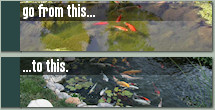
 Got those green water blues? We can help!